Thursday, February 2, 2012

“StatsCan loses top economic analyst over census”

I have to say I’m having some difficulty getting incensed over this story. (Stats Can loses top economic analyst over census).

A top Statistics Canada official has resigned his post, citing the end of the mandatory long-form census and the stifling of debate at the agency as his reasons for leaving.

Chief economic analyst Phillip Cross was with the agency for 36 years.

After 36 years with the agency, Cross didn’t “resign”, he retired. And it sounds like he retired to a nice cushy position with the C. D. Howe Institute.

As valid as his claimed issues might be, I’d be a lot more accepting of a story describing a principled resignation if Cross had lined up with Munir Sheik last year and walked out the door at the same time. Instead this seems more like Cross went looking for a soft landing to supplement his not insignificant civil service pension, and only then claimed a principled departure for purely political reasons.

“Federal bureaucrats posed as ‘new Canadians’ for Sun News event”

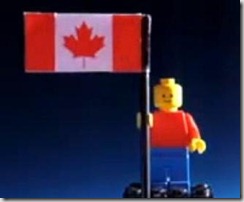
Lego man jason kenney

And don’t forget to tune in at noon today when SUN TV’s Ezra Levant interviews Jason Kenney, Canada’s Minister of Citizenship, Immigration, and Multiculturalism, here seen holding the flag at a recent citizenship ceremony.

Wednesday, February 1, 2012

An unlikely ally

happy-housewifeBrad Trost represents, in my opinion, the very worst of the Conservative Party. A true Reform-a-tory he would have us all living back in the 1950’s when men were men and the little lady was barefoot, pregnant, and in the kitchen. As conservative as Saskatoon-Humboltd may be I cannot believe that his ideas represent the thinking of a majority of its residents; instead, I expect by wrapping himself in Conservative blue he was able to cruise to victory without anyone seriously questioning his credentials or beliefs, or even caring.

So, given my personal views on Mr. Trost, I find myself now quite surprised to be agreeing with him on his latest crusade against party discipline in Ottawa. (link) I have posted on this topic before (here), bemoaning the fact that so many supposedly intelligent and independent thinkers roll over and play dead as soon as they arrive in the Nation’s Capital. In my opinion, no job warrants selling your soul to keep your self-proclaimed ‘boss’ happy and I immediately lose respect for anyone who does so voluntarily. (In fact, their real bosses should be the electorate who put them in Ottawa, not Harper, Rae, et al, who can apparently control their behaviour with the promise of a cabinet post some day, or at least their very own car and driver.)

So I am following the musings of Mr. Trost with some interest. Admittedly there is a degree of schadenfreude involved in my desire to see more Conservative backbenchers revolt against the tyranny of the PMO and more specifically Harper’s choke collars installed upon the necks of his caucus members, but I also think the current state of affairs is bad for Canadian democracy. (For the record, the Harper Cons aren’t the only party to keep their caucus members on a short leash – it’s become endemic in Ottawa.)

trostWhether this is just a flash in the pan, public musings by a disgruntled MP, or something more will depend on what happens next. Either other backbench MPs will start to speak out (Where is Max Bernier?), or Harper will give a quick tug on the leash and Mr. Trost will slide back into a position of irrelevance until he experiences another momentary flash of integrity and lets us know what he really thinks.

Thursday, January 5, 2012

We have a pill for that

Fat monkeys of the world, rejoice! A new fat-starving drug has been successful in reducing the amount of fat in experimental apes by as much as 11 percent of body weight. Researchers are all agog with dreams of the drug’s applicability to not only reduce weight but, by extension, also reduce certain cancers, etc. in the human population.

But is this really a success story we should be celebrating?

We have become a society of pill-takers. This is not new, but technology seems to have accelerated the pace of “miracle cures” for problems that we should be trying to avoid in the first place. If you have an obesity problem, exercise more and don’t eat so many Big Macs. But instead we say, go ahead, don’t worry about self control or discipline, we can fix you up later. (I know, there are people for whom obesity is truly a medical issue, but they are an insignificant number compared to the 25% of the population deemed obese by the Public Health Agency of Canada in 2007.)

Cancer is no different. Literally billions of dollars are spent trying to find a cure for a disease which we know is, in large part, triggered by lifestyle choices. How much is spent on prevention? Other than anti-smoking campaigns, a pittance. So go ahead and pollute the Athabaska River with tar sands run-off, spray our food crops with pesticides and fungicides and other toxins, chemically treat our fabrics and building materials, continue to mine and export asbestos to India, and when you get sick, which you inevitably will, we hope to have a pill for that too. (And by the way, please send more money.)

If we were to take the same approach to drunk driving we would celebrate the availability of cheap caskets as a solution to the problem of impaired drivers on our roads.

Life is all about choices. Some are easy (what to have for dinner) and some are hard (quitting smoking). If we as individuals, corporations, and governments really wanted to improve health and reduce medical costs we’d be spending as much money or more on the prevention side of the ledger as we do on the cure side. It only makes sense.

Friday, December 16, 2011

Shorter Gerry Ritz: “I have no effing idea”

It turns out that my previous post on government’s attitude towards the use of public funds was a perfect segue into this post.

Gerry_RitzGerry Ritz was on Power and Politics today defending his government’s action on the Canadian Wheat Board. Personally I have no opinion on whether dismantling the Board is a good idea or not. Logic would say an open market is better, but growing and selling wheat is not my business, so I don’t know. (Note however I do have an issue with the Harper government refusing to honour Section 47.1 of the Act that called for a farmers’ plebiscite before changing the Act, but that’s now a moot point as the Act has become law.)

During the interview the host, Chris Hall, tried to get Gerry Ritz to tell him what the expected cost to taxpayers would be from dismantling the existing Canadian Wheat Board. Ritz bobbed, weaved, and obfuscated, never coming close to answering the question, because clearly he didn’t know.

But it was this particular exchange that really lit my fire:

CHRIS HALL: So you think though that you can handle these outstanding costs? (…) Ultimately you feel that this can be handled within the confines of the money that's available now?

GERRY RITZ: Well absolutely because the Treasury of Canada will be available for those extraordinary costs.

So, in a nutshell, the government has no idea what the costs will be of implementing this particular legislation, but it doesn’t really matter because “the Treasury of Canada” will be available. And in case it isn’t abundantly clear, that’s you and me, folks.

Kind of gives you that warm and fuzzy feeling that these guys are the best custodians of the public purse, doesn’t it?

What would Peter do?

The Canadian Taxpayers’ Federation has recently been uncovering some rather embarrassing expenses incurred by the Minister of National Defence, including $3,167 for flights to Boston to attend a “seafood show”. (To be fair, Mackay isn’t the only politician to abuse the public purse, he just happens to be the one who is doing so most outrageously at the present time.)

In response I threw up a quick Facebook comment suggesting that money could be much better spent on a variety of social services such as the Ottawa Mission ($3167 would provide more than 1,000 Christmas dinners for those who have no home to go to this year), women’s shelters, or halfway houses. But then I got thinking about it some more.

taxpayerThe problem is – as has always been the case in government – they are not spending their own money but rather money that comes from a bottomless pool (at least from the average politician’s/bureaucrat’s perspective). Now I don’t think for a moment that Peter Mackay, if he considered the cost at all,  thought about how that money could be better spent for the “greater good”.  And I am certain that his people didn’t either. (“The boss wants to go to this seafood thing, so better book the tickets. Never mind what it costs.”)

But imagine what would have happened if, for example, when Stephen Harper realised that his 2-day G8 photo-op was going to cost $2 BILLION or thereabouts, he said to his team, “That’s ridiculous. If we have $2 billion to spend let’s put it somewhere useful. Cancel the G8 meeting, we’ll do it by teleconference, and redirect that money to social programs for the homeless.” Just think what that would have meant for the homeless in this country, or anyone else to whom the money was directed (gazebos in Muskoka don’t count). And think about the legacy that would have created for Stephen Harper and his Conservative government.

But governments don’t think that way. Unlike those of us who have to live within our means, they don’t have to adhere to a zero-sum budget – if A gets $B then Y can only get $Z is a foreign concept to bureaucracies. And with nearly 300,000 federal public servants and countless provincial and municipal employees all sucking off the one taxpayer teat it doesn’t take long before it’s totally out of control – as it is now. So I applaud the Harper Conservative’s pledge to reduce taxes (if only they were smarter about it), but I would applaud even louder if they were to reset the priorities and direct the money they do collect to issues of concern to most Canadians – which, contrary to the Harper agenda, are NOT F-35 fighter jets, more and bigger prisons, tax breaks to the oil sands, or flying to a “seafood show” in Boston.

This is a wealthy country and governments collect more than enough revenue to meet our real domestic obligations. All they need to do is align spending with Canadians’ priorities (and I’m not referring here to the ~24% of eligible voters who elected the Conservatives, but rather the broader 100%, all Canadians, most of whom don’t drink the Conservative kool-aid).

Anyone who does that and clearly (and transparently) treats the public purse as if it were his/her own could count on running this country for a long, long time.

Friday, December 2, 2011

Caught between two worlds

With all the negative news coming out of Attawapiskat these days it’s easy to simply assign blame to a) the government; b) the reserve; c) the Canadian public, or d) all of the above. And in spite of the government’s assigning of a third-party manager the solution will, in all likelihood, eventually amount to more money going into supporting the same dysfunctional model.

Let’s be brutally honest here – there is no future in Attawapiskat. There may be a few construction jobs available with the mines and some service jobs in the local hotel, but that’s the extent of it. And it’s not only Attawapiskat. There are dozens of reserves scattered all  over Canada’s north, in places so remote they can either only be accessed by air or by winter ice road.

A hundred years ago (or even fifty in some cases) this didn’t matter. The people who lived in these remote settlements really did live off the land. They hunted, trapped, and fished and had a pretty good, if austere and challenging life. And yes, they spent the winter in tents, even when the temperatures did plummet to –40 on occasion.

But now that lifestyle is no longer viable, even if it is often idealised by native leaders in support of land claims and so on. The number of aboriginals who want to live the way of their ancestors at the time of the various treaty signings are dwindling quickly, amounting to no more than a few elders and those who would romanticise the past. Instead, today’s young aboriginals want the same things the rest of us want. They want televisions and computers with internet access. They want to get a good education. They want cars and trucks and good roads to drive them on. They want hospitals down the street and groceries that don’t have to be flown in at a ridiculous cost. They want a future that doesn’t involve trekking hundreds of miles to follow the herds.

So they are caught between two worlds, with a foot, literally, in each of two rapidly diverging cultures. If they are not to be figuratively split in two they will soon have to decide which way to go because both are not an option - that way lies Attawapiskat.